3 posts tagged with "Security"

Secrets and auth

View All Tags

How We Score MCP Server Security: 18 Rules, Two Published Taxonomies, Zero Invented Checks

· 8 min read
MCPBundles

You paste an MCP server URL into a security analyzer. It spits out a number. You ask the obvious question: what does that number actually mean?

Most MCP scanners can't answer it. They run a bunch of regex, run a bunch of LLM prompts, and produce a verdict. If you push on the verdict, you find ad-hoc heuristics with no published source — and worse, you find marketing claims about "AI-powered security analysis" that nobody can audit.

We built MCPBundles' analyzer the other way around. Every rule cites a published taxonomy entry. If we can't cite an entry, the rule doesn't ship. The catalog is small, deliberate, and live: www.mcpbundles.com/learn/mcp-security.

This post is the "show your work" version of that page.

OFAC Sanctions Screening API: Search Watchlists from Claude, ChatGPT, or REST

· 4 min read
MCPBundles

If you run vendor onboarding, finance operations, marketplace trust, logistics compliance, or diligence research, sanctions screening is often one step inside a bigger decision. The team is not asking for a database. They are asking whether a counterparty can move forward.

The question sounds simple: "Is this company or person on a sanctions list?" Then reality gets in the way. Which list? Which alias? Is this a close match or just a similar name? Do we need to record the source list, the country, the identifier, and the reason for the match? Is this a vendor review, a customer onboarding step, or a shipping workflow where denied-party screening is only one part of the decision?

That is what the Global Sanctions & Watchlists MCP server is built for. It gives an agent a normalized sanctions search surface so the lookup can happen inside the workflow that needs the answer.

Open-Source CVE Triage: Combining NVD, CISA KEV, and EPSS in One MCP Server

· 6 min read
MCPBundles

Your vulnerability scanner dumps 200 CVEs. You sort by CVSS score. The CVSS 9.8 at the top gets your attention. You patch it first.

Meanwhile, a CVSS 5.0 three pages down is in active ransomware campaigns. CISA added it to the Known Exploited Vulnerabilities catalog last week. EPSS gives it an 80% exploitation probability. Nobody looked at it because it was page three.

CVSS tells you how bad a vulnerability could be. It says nothing about whether anyone is actually exploiting it. For that, you need two more data sources — and nobody combines all three in one place.

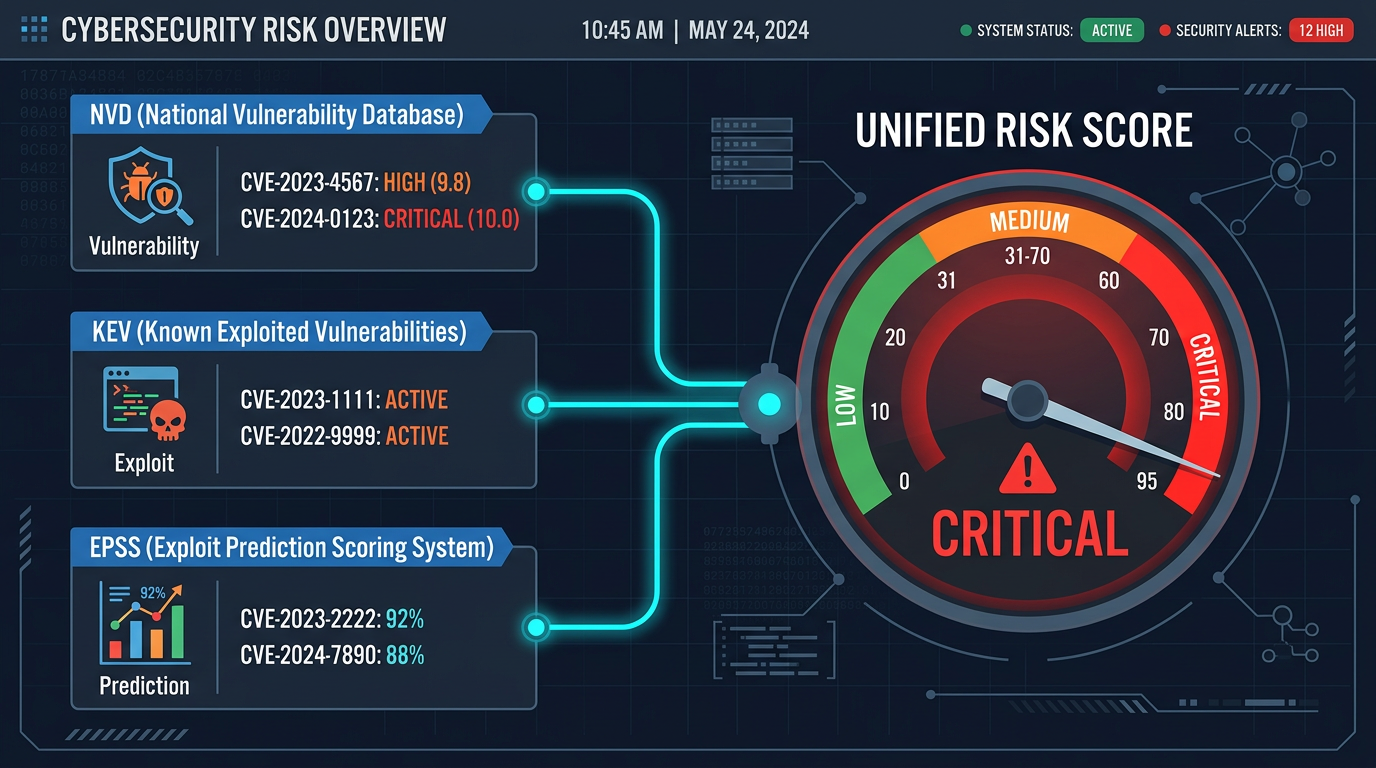
Until now. vulnerability-intelligence-mcp is an open-source MCP server that pulls from NIST NVD, CISA KEV, and FIRST.org EPSS, computes a composite risk score, and gives your AI 30 tools for CVE analysis, watchlist tracking, and scanner triage.

Three vulnerability data sources (NVD, KEV, EPSS) converging into a unified risk score gauge
Three federal data sources, one composite risk score.