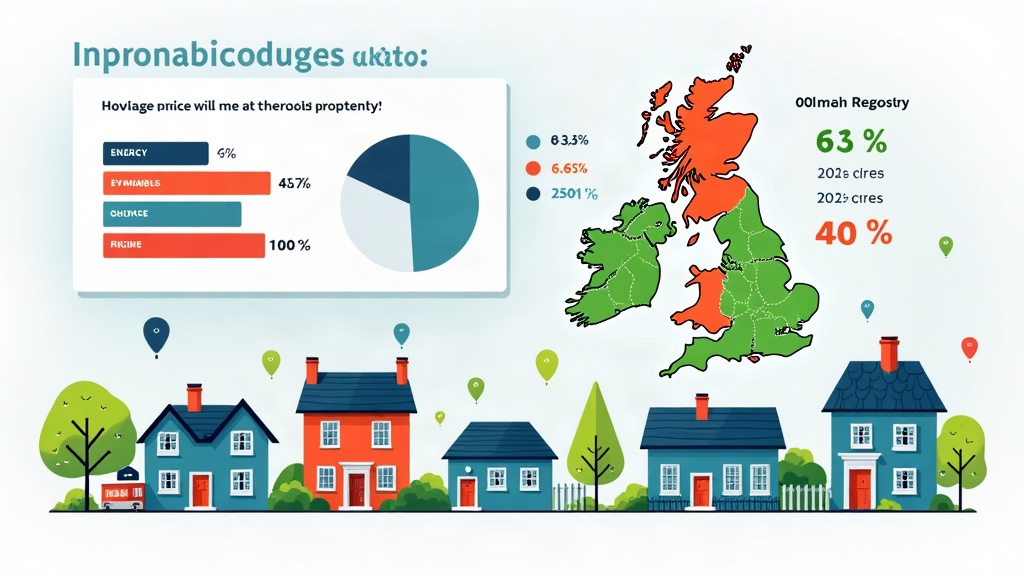
UK House Price Data with AI: EPC, Land Registry & Price-Per-Square-Foot Evidence
TL;DR
- Query 30.8 million EPC certificates, 2.7 million UK postcodes, and 1.34 million persisted Land Registry–EPC matches through the UK Property Intelligence app and MCP server.
- Resolve an address or postcode, pull HM Land Registry sold prices, join EPC floor area where the match is strong, and return price-per-square-foot bands with explicit confidence flags—not a black-box valuation.
- Built for lenders, property analysts, retrofit planners, and AI agents who need show your working evidence before formal RICS sign-off.
Most AI valuation demos make the same mistake. A user types an address, the model returns a number, and everyone pretends the answer came from evidence.
That is backwards. UK property questions are only useful when the agent can show its working: nearby sold prices, EPC floor area, property type, transfer dates, postcode geography, match confidence, and the gaps where public data is thin.
We built UK Property Intelligence around that evidence loop — a bounded, inspectable report from sold prices, EPC records, and postcode context, not a false-certainty number.
A valuation starts with comparable evidence
A prompt like "value 22 Monument Road Weybridge" should not send the agent into a national fuzzy search. It should first resolve the address into a bounded place, then gather evidence around that place.
Start by resolving the address into a bounded postcode. Pull recent HM Land Registry sales for that postcode and street. Join EPC records where the match is strong enough to trust floor area and property type. Build price-per-square-foot observations only from comparables you'd actually use — and say what you dropped because the EPC join was weak, the floor area was missing, or the sale was too old.
That last step is the one people usually skip. A valuation band is more credible when it admits that one sale was an outlier, one EPC match was not strong enough, and three nearby properties were the wrong shape.
Why sold prices and EPC records belong together
HM Land Registry Price Paid Data is the transaction spine. It records sale price, transfer date, tenure, property type, and address evidence. It does not consistently give you the floor area, energy rating, or enough property context to compare a flat with a terrace in the same postcode.
EPC data fills a different part of the picture. It can add floor area, property type, energy rating, construction age band, and address evidence. It also has caveats: records can be old, address strings are not uniform, and not every property has a fresh certificate.
Joining the two turns "sold house prices" into better valuation evidence. A £420,000 sale means one thing for a 47 sqm flat and another for a 91 sqm maisonette. The price-per-area view is where the agent can stop repeating raw prices and start explaining the market.
Postcode reports are a better default than national search
Property data rewards bounded questions. A full postcode query returns fast, relevant slices; a vague address fragment across the whole country turns slow and noisy.
UK Property Intelligence leans into bounded workflows. Postcode reports combine local sales, EPC context, geography, activity, distributions, and price-per-area evidence. Address lookups use structured facts when they are known. Fragment filters stay inside a defined scope.
That shape matters for agents. It keeps a casual user prompt feeling natural while keeping the underlying data path deterministic enough for production.
EPC ratings turn valuation into risk and retrofit work
House price data answers one question. EPC data opens several more.
An analyst can ask which low-rated homes in a postcode have sold recently, which flats have enough floor-area evidence for comparison, or whether lower EPC bands show a measurable value gap in a local slice. A retrofit planner can look for clusters of E to G rated properties without downloading raw certificates. A lender can ask for caveats before treating an address as a clean comparable.
The point is not that an EPC rating alone predicts value. It is that energy performance becomes one more explainable signal alongside property type, floor area, sale date, and location.
Agents need confidence flags, not just answers
The model should never hide the quality of the evidence from the user. A good property report says how many matched comparables were found, how recent they are, whether the EPC join was deterministic, and which caveats affect the valuation range.
When public data is thin, a confidence flag is the only honest answer. Some properties have premise-level evidence; some only resolve to street and postcode; some have sold prices but no usable EPC match. The report should label the tier instead of flattening every case to the same certainty.
What to try first
For a single-address valuation, try "value 22 Monument Road Weybridge" or "value Flat 6 Munro House, 14 St Cross Street." The agent should resolve the address, gather local comparables, use EPC floor-area evidence where available, and return a valuation band with caveats.
For a postcode review, ask for recent sales in the last year, median price, property-type mix, EPC rating distribution, and price-per-square-foot observations — e.g. "build a property report for HA9 0DY." That gives a single address the local context it needs.
For retrofit targeting, ask for EPC ratings E to G in a postcode, then layer recent sale history: "search EPC records in HA9 0DY and show properties with ratings E to G."
Reference docs, the interactive report app, and live example prompts are on the product page: UK Property Intelligence.